

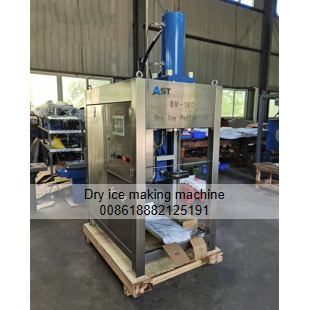
The dry ice machine is a specialized dry ice maker machine designed to convert liquid carbon dioxide (LCO2) into solid carbon dioxide (dry ice). While structural details vary between dry ice pelletizer machine and dry ice block maker machine models, they all comprise the following five core functional modules:
1.CO2 Inlet and Pre-cooling Module
CO2 Inlet and Valve: Connects to the liquid carbon dioxide (LCO2) storage tank and regulates the flow of liquid CO2 into the system.
Pre-cooling and Pressure-reduction Device: Uses an expansion valve or nozzle to rapidly reduce the pressure and expand the liquid CO2; the resulting partial vaporization absorbs heat, causing the remaining CO2 to solidify into snowflake-like dry ice.
2.Molding and Compression Module
Molding Chamber (Compression Chamber): The core component of the dry ice making machine; it holds the snowflake-like dry ice and allows for the application of high pressure to compress and shape it.
Piston/Plunger: Driven by hydraulic or mechanical force, it moves reciprocally to apply pressure to the dry ice, forcing it through the molding die.
Molding Die: Determines the shape of the dry ice (e.g., pellets or blocks); dies of various specifications are interchangeable.
3.Hydraulic and Power Module
Hydraulic System: Includes the hydraulic pump station, hydraulic cylinders, and other components; provides high-pressure power for the movement of the dry ice machine's piston.
Motor: Provides electric drive power for the hydraulic pump station and machine operation.
4.Electrical Control and Operation Module
Control System: Typically consists of a PLC and a touchscreen; responsible for logic control, parameter settings, and monitoring of operating status.
Human-Machine Interface (HMI): Used by the operator for start/stop control, parameter adjustment, and fault alarms.
5.Auxiliary and Support Modules
Frame and Enclosure: Provides structural support for the dry ice machine. The dry ice machine from Sichuan Aosituo features a fully enclosed stainless steel design that is dust-proof and leak-proof, whereas some other dry ice machine manufacturers utilize an exposed design without an enclosure.
Cooling and Heat Dissipation System: Some dry ice machines are equipped with hydraulic oil cooling or air-cooling systems to maintain optimal operating temperatures.
Discharge and Collection Mechanism: After compression molding, the dry ice is extruded through the mold and falls into a storage bin or onto a conveyor belt; some dry ice machines are equipped with automatic pushing or ejection devices.
Add comment
Comments